
A mobile app for business is a powerful tool, but not a universal one. It costs more to build and maintain, people have to install it, and it only pays off when customers use it regularly. A website, on the other hand, is available straight from search, but does not have all the capabilities of a phone. Let's work out what to choose in your situation.
The main difference in one minute
A website opens in a browser from a link or from Google — there is nothing to install. A mobile app is downloaded from the App Store or Google Play and lives on the person's phone: with an icon on the screen, notifications and access to the camera, location and other device features.
Hence a simple rule: a website is for being found, an app is for being come back to.
Website vs mobile app
| Criterion | Responsive website | Mobile app |
|---|---|---|
| How people get there | From a link, from search | They have to find and install it |
| Google search | Indexed, brings new customers | Not indexed like a website |
| Development cost | Lower | Higher (often iOS and Android) |
| Updates | Instant for everyone | Through the stores, people update later |
| Push notifications | Limited | Fully supported |
| Working offline | Limited | Possible |
| Camera, location, biometrics | Partly | Full access |
| Regular use | The person has to remember you | The icon is always on the screen |

When a website is enough
If you need new customers to find you and send requests, start with a website. It works when:
- customers come to you rarely: renovation, lawyers, travel, B2B services;
- your main source of customers is Google search and advertising;
- you need to launch quickly on a limited budget;
- the features come down to information, a catalogue, forms and payment.
A modern responsive website works great on a smartphone: it opens quickly and has convenient navigation and forms.
When you need a mobile app
An app makes sense when:
- customers use the service often — daily or weekly: delivery, banking, fitness, learning, a loyalty programme;
- you need phone features — camera, location, video calls, biometrics, Bluetooth;
- push notifications matter — order status, reminders, promotions;
- the service has to work offline or with a poor connection;
- the app is the product itself, not an add-on to the business.
An example from our practice is Servis UTOG: an app for sign language interpreting over an online connection. It needs video calls and quick access from a phone, so an app is the natural solution.
The middle ground: a PWA
A progressive web app (PWA) is a website that can be "installed" on the phone's home screen. It can work with a cache, partly offline, and send notifications (with limitations, especially on iPhone). A PWA is a good compromise when you want the feel of an app at a price closer to a website.
Native or cross-platform app
- Native — separate code for iOS (Swift) and Android (Kotlin). Maximum speed, the best system integration and accessibility for screen readers. More expensive, because it is effectively two products.
- Cross-platform — one codebase for both platforms. Faster and cheaper at the start, suitable for most business apps.
The choice depends on features, budget and growth plans — we advise after analysing the task.
Start with an MVP
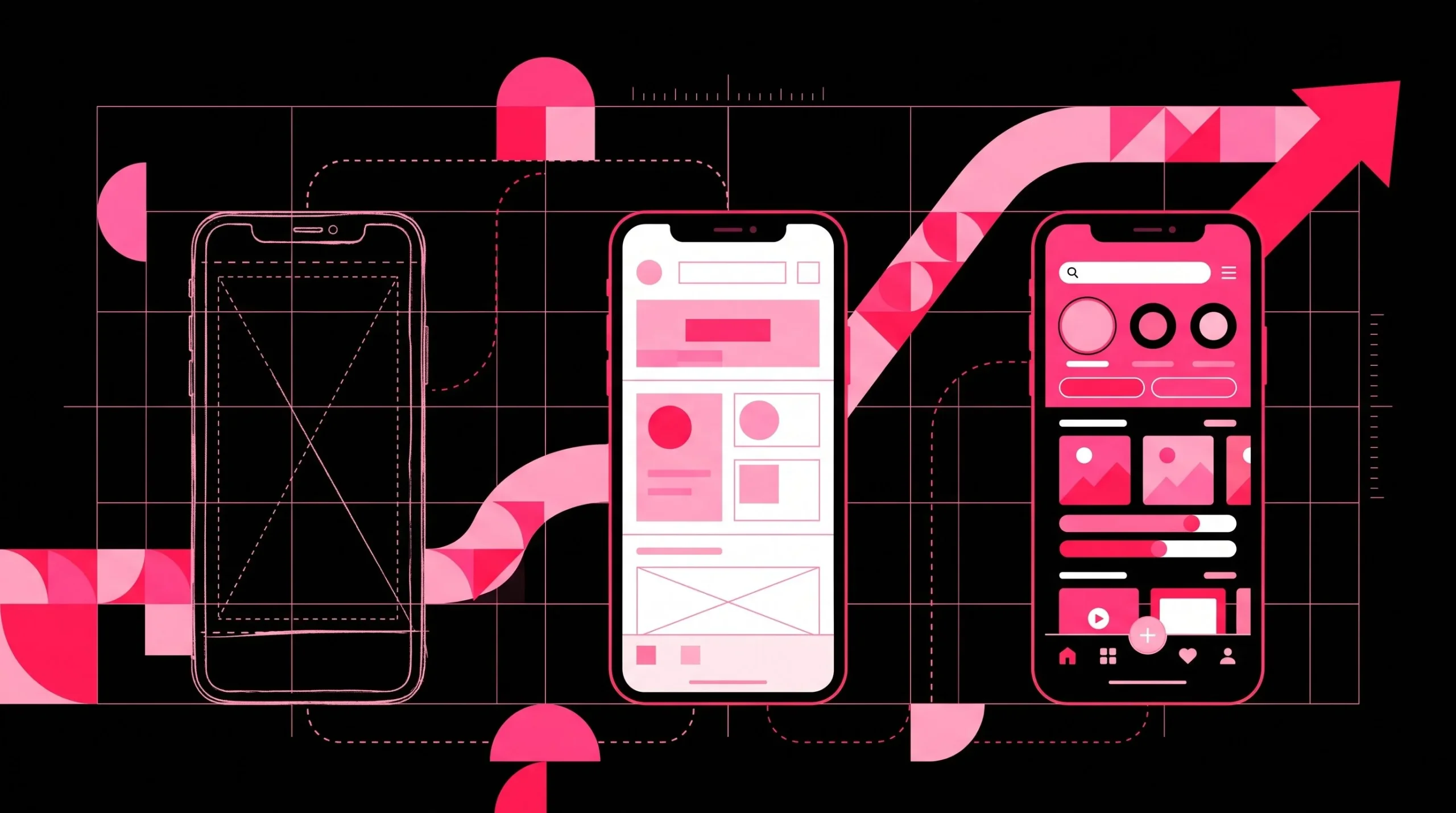
An MVP (minimum viable product) is the first version with the most important features. Instead of spending a year building the "perfect" app, you launch the core in a few months, watch real users and develop what is actually needed. An even cheaper first step is a clickable prototype: it lets you test the idea before any programming.
7 questions to help you choose
- How often will a customer use the service?
- Where will new customers come from — search, ads or your existing base?
- Do you need the camera, location, video calls or offline work?
- Are push notifications important for your model?
- What is the budget for development and, more importantly, for maintenance every year?
- Do you already have a website that brings customers?
- Are you ready to motivate people to install the app (bonuses, convenience, exclusive features)?
If most answers are "rarely", "from search", "no" — start with a website. If they are "daily", "yes" and "needed" — it's time to think about an app. And most often the best combination is a website to attract customers and an app for regular ones.
How we can help
We build both websites and mobile apps for iOS and Android — so we don't "sell" one instead of the other, we recommend what suits your business. You can start with a prototype: after it, it becomes clear what exactly you need and how much it will cost.
Send us a request — we will look at your idea and suggest a solution.