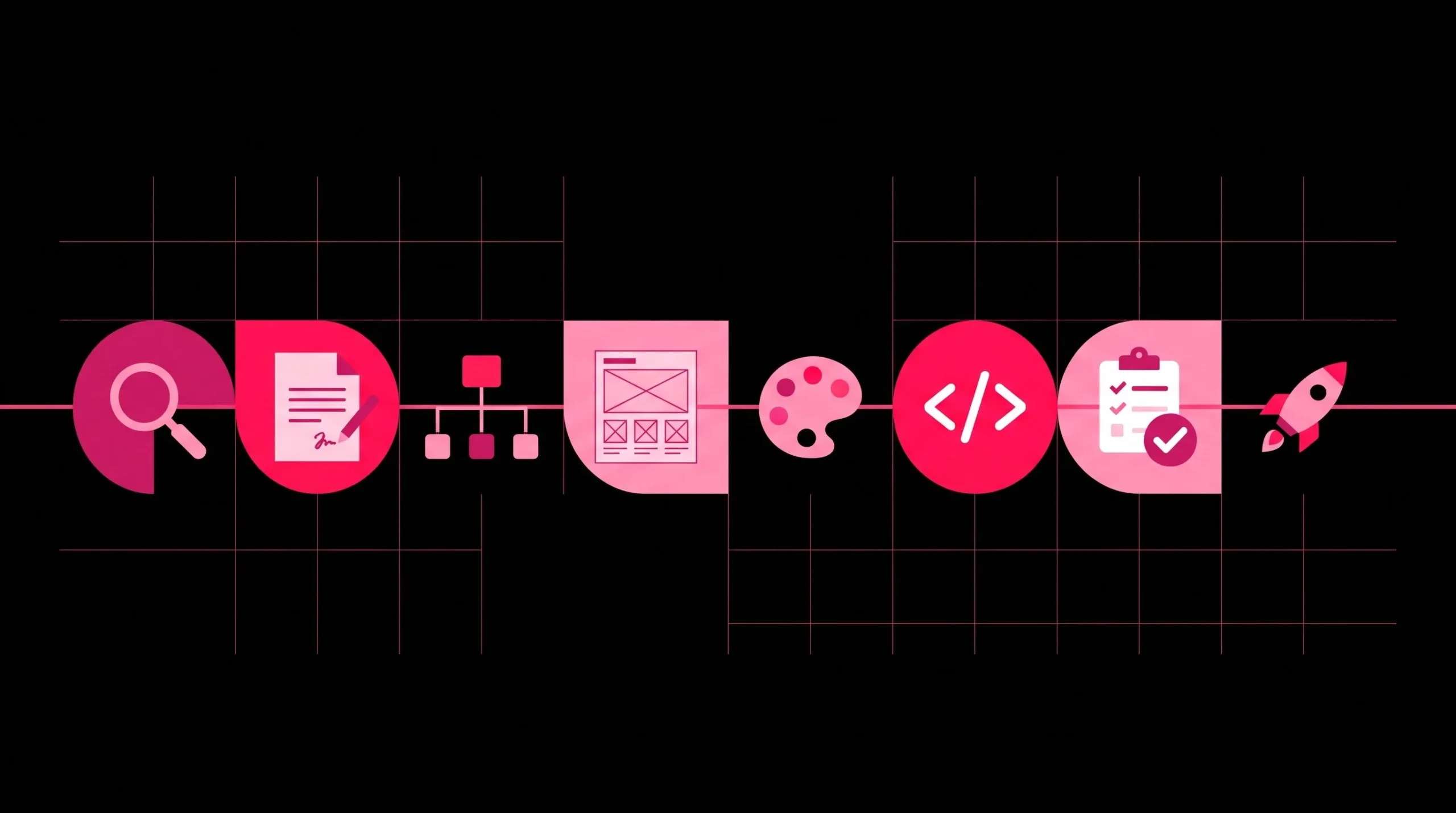
Website development stages are the sequence of steps from the first conversation to launch: research, contract, planning, prototype, design, development, testing and publishing. When you know these stages in advance, the project does not turn into a "black box": it is clear what is happening now, what is needed from you and when the result will be ready.
Below is how it works at QD studio. We work this way on every website: from a landing page to an online store. Only the amount of work at each step differs.
Why website development stages matter to you
A website built "in one go" almost always gets rebuilt. The designer draws beautiful screens, and then it turns out a delivery page is missing, the form doesn't fit your CRM and the texts don't fit the layout. Every such discovery at the end of a project costs three times more than at the beginning.
Clear stages solve three problems:
- A predictable budget. The scope is fixed before the start, not "along the way".
- Fewer revisions. You approve the structure and prototype before the design, so the design doesn't have to be redone.
- Clear deadlines. Each stage has its own date, and you can see where the project is now.
1. Research: what we are building and for whom
It all starts with your request — through the form on the website, by e-mail or in a messenger. We communicate in writing: that way every agreement is recorded immediately, and nothing gets lost after a call.
At this step we find out:
- what problem the website should solve: leads, sales, trust, hiring;
- who your customers are and what devices they use;
- who your competitors are and how you differ from them;
- what you already have: a logo, texts, photos, a domain, an old website.
Your role: answer the questions and send examples of websites you like (and don't). Time: 1–3 days.
2. Contract: price, deadlines, revision rules
After the research we suggest a format and an estimated cost. You can calculate it yourself in the calculator. Next comes the contract, which fixes:
- the scope of work: pages, features, integrations;
- the deadline for each stage;
- the number of revision rounds;
- the payment schedule (usually in parts, by stage).
Time: 1–2 days.
3. Planning and technical specification
At this stage of website development we create the structure — a map of all pages and the links between them — and the technical specification. The specification describes what each page must do: which blocks, forms, filters, integrations. More on this in the article "How to write a website specification".
Here we also plan SEO: which search queries each page will target, so that Google finds the website from day one rather than "we'll fix it later".
Your role: approve the structure. Time: 3–7 days.
4. Prototype: a skeleton without colours
A prototype is a scheme of the pages without colours or photos: where the heading goes, where the button is, where the form is, in what order the blocks come. On a prototype it is easy to rearrange blocks or add a new one — minutes of work, not days as in a finished design.
We make prototypes for desktop and mobile at the same time, because most visitors now come from a smartphone.
Your role: approve the page logic. Time: 3–10 days.
5. Design: style, colours, details
Once the skeleton is approved, the designer "dresses" it in your style: colours, fonts, photos, icons, animations. If you don't have a visual identity yet, we start with branding — otherwise the website would have to be repainted once a logo appears.
We check accessibility separately: text contrast, button size, visible keyboard focus. This is part of the design, not an "option" — we explain why in the article "Website accessibility".
Your role: approve the layouts, prepare texts and photos. Time: 1–3 weeks.
6. Development: front end and programming
Developers turn the layouts into a live website: front-end coding for all screens, an admin panel for editing, forms, payments, integrations with a CRM or delivery services. We work on our own CMS, QAdmin: it is fast, has no unnecessary plugins and makes it easy to edit texts yourself.
During development the website lives at a test address hidden from Google. You can open it and see how the work is progressing.
Time: 1–6 weeks depending on the features.
7. Testing: we check everything before launch
Before launch we check:
- how it looks on phones, tablets and computers in different browsers;
- loading speed (PageSpeed, Core Web Vitals);
- forms and requests: whether e-mails arrive and the manager sees them;
- accessibility: keyboard navigation, alt text, contrast;
- the SEO basics: headings, descriptions, sitemap, redirects from the old website.
Your role: go through the website as a customer and write down everything that seemed odd. Time: 2–5 days.
8. Launch and the first weeks after it
Launch is not just "pressing a button". We move the website to your domain, turn on HTTPS, connect Google Search Console, submit pages for indexing and set up redirects if there was an old website.
After launch the website stays under supervision for a few more weeks: we check whether requests arrive, how Google indexes the pages, whether there are errors. Then — if you wish — support: updates, new pages, help with content.

How long website development takes overall
| Website type | Approximate time |
|---|---|
| Landing page | 2–4 weeks |
| Corporate website | 4–8 weeks |
| Online store | 8–14 weeks |
Most often the timeline slips not because of development but because of content: texts and photos that are prepared in parallel. So we ask you to start collecting materials already at the prototype stage.
Two more typical reasons for delays are long approvals inside the company (when five people need to see a layout) and new ideas in the middle of development. The first is solved by one responsible person on your side. The second by a "later" list: we will gladly add new features after launch without moving the date.
In short
The eight stages of website development — research, contract, planning, prototype, design, development, testing and launch — are a way to build a website once and build it well. You approve every step, see the progress and don't pay for rework. Ready to discuss your project? Write to us — we will reply with questions and an approximate plan.