Developing a website is not buying a finished product but creating one for a specific business. That is why the price of website development in Ukraine can differ tenfold: from a few thousand hryvnias for a template landing page to hundreds of thousands for an online store with integrations. Let's see where the difference comes from and how to plan a budget. For reference, we give approximate US dollar amounts in brackets.
Approximate market prices
Ukrainian studios publish roughly these price ranges for turnkey website development (data from one of the open market guides, 2025):
| Website type | Approximate cost | Who it's for |
|---|---|---|
| Landing page | UAH 5,000 – 15,000 (≈ $110 – 330) | one product, service or event |
| Portfolio website | UAH 10,000 – 25,000 (≈ $220 – 540) | specialists, creative professions |
| Corporate website | UAH 20,000 – 60,000 (≈ $430 – 1,300) | companies with several services |
| Online store | UAH 25,000 – 100,000+ (≈ $540 – 2,200+) | selling goods online |
| Custom project | UAH 50,000 – 500,000+ (≈ $1,100 – 11,000+) | services, user accounts, complex logic |
This is not the QD price list but market benchmarks. The lower end usually means a template design and ready-made solutions, the upper end a unique design, complex features and integrations. Prices depend on the region, the team and the exchange rate.
Another benchmark is the hourly rate. For Ukrainian web studios it often starts at around UAH 1,500 (≈ $33) per specialist hour. Multiply that by the hours of design, front-end coding, programming and testing — and it becomes clear why a complex website cannot cost as much as a landing page.
What the cost of a website depends on
1. Type and scale of the website
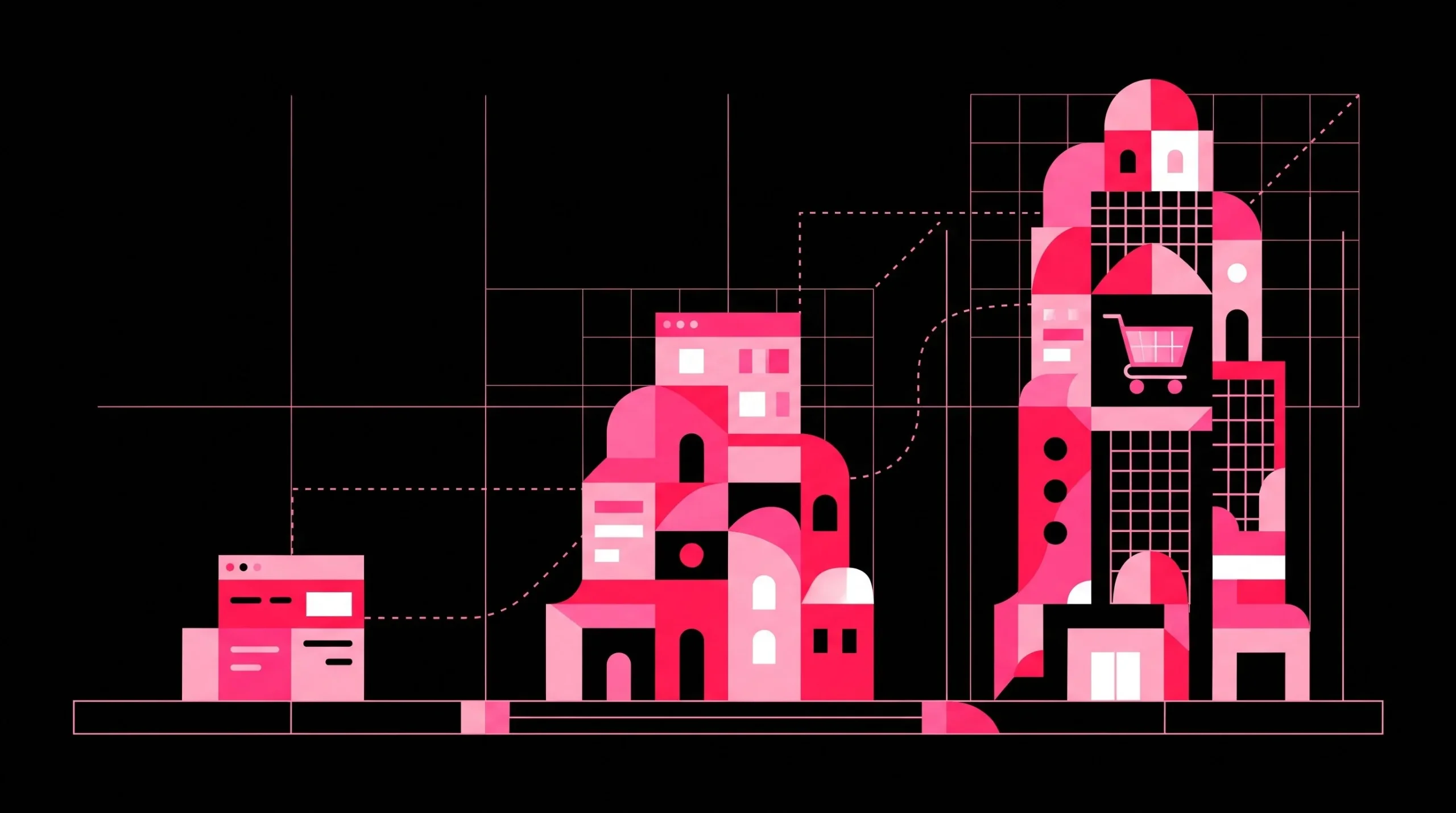
The more pages, templates and scenarios, the more work. A landing page is one page with one goal. A corporate website is dozens of pages, a blog, a portfolio, several forms. An online store is a catalogue, filters, a cart, payment, delivery and a user account. On choosing the type of website, see also our article about the technical specification.
2. Design: template or unique
A ready-made template is cheaper, but your website will look like hundreds of others. A unique design is created for your brand and audience: from a prototype to layouts for desktop, tablet and smartphone. It is a significant part of the budget — and it is what sets you apart from competitors.
3. Features and integrations
Online payment, delivery, CRM, accounting, multiple languages, a user account, calculators, booking — each feature adds hours of development and testing. Integrations with third-party services are especially unpredictable: discuss them before the start.
4. Content
Texts, photos, videos, translations. Clients often plan to "fill it in themselves", and then the launch is postponed for months. If the studio writes the texts and takes the photos, that is a separate cost item — and usually a very worthwhile one.
5. Platform
A website builder, WordPress, a custom CMS or bespoke development. What matters is not only how much the start costs but also how much maintenance will cost: updates, security, new features.
6. Quality "under the hood"
Loading speed, responsiveness, basic SEO, security, accessibility for people with disabilities. These things are invisible in a mock-up, but they decide whether the website will bring customers.
7. Who builds the website
A freelancer is usually cheaper but is responsible for everything alone. A studio costs more, but a team works on the project: analyst, designer, developer, tester, manager. Both options are valid — what matters is that the scope of work matches your task.
Hidden costs people forget about
Development is not the only budget item. Also plan for:
- a domain and hosting (paid yearly);
- an SSL certificate (often free, but it has to be set up);
- content: texts, photos, videos;
- paid services: payments, newsletters, chats, delivery services;
- support after launch: updates, small changes, backups;
- promotion: ads, SEO, social media — without them nobody will find even a perfect website.
For online stores, the authors of one market guide advise budgeting 40–60% more for the launch than the development itself costs. The figure is approximate, but the principle is right: count not only "build it" but also "launch and maintain it".
How to get an accurate website development price
- Define the goal. Not "we need a website" but "we need requests for flat renovations in Kyiv" or "sell fabrics across Ukraine".
- Collect examples. 3–5 websites you like and 1–2 you definitely don't. Write what exactly you like.
- Separate must-haves from nice-to-haves. What you need at the start and what can be added in a second phase.
- Fill in a brief or write a short technical specification.
- Compare offers by the scope of work, not by the final number. A cheaper offer often simply leaves out half of what the more expensive one includes.
How not to overpay
- Start with the minimum you need. A landing page or a small website, then grow it based on real data.
- Don't pay for "future" features nobody is asking for.
- Clarify who owns the website: you should have access to the hosting, the domain and the admin panel.
- Check the portfolio and talk to the studio's previous clients.
- Fix everything in the contract: stages, deadlines, the number of revisions, what the price includes.
How much a website costs at QD
We don't publish fixed prices, because we estimate every project for its task. After a short brief you get a work plan, a timeline and a cost — broken down by stage, so you can see exactly what you are paying for. To get started we offer three formats: a landing page, a corporate website and an online store.
Send us a request — we will estimate the cost of your website and suggest where you can save without losing quality.
Sources (in Ukrainian): WebsCraft: turnkey websites in Ukraine — price benchmarks · WebsCraft: how much an online store costs in Ukraine in 2026 · DOU: an example of a web studio's hourly rate